A real-life friend of mine (who actually reads this blog) commented yesterday (in person) that he was contemplating writing a novel in November. It was ten years ago when he and I wrote our first November novels.
The novel I wrote that year was one that I'd been carrying around inside me since 1990 when I scribbled the first scenes in a notebook I'd purchased in Italy. I won't try to reconstruct the order and history of my November novels today, but I will only say that I thought I would return to the same set of characters each November and write another chapter in the ongoing saga of their lives. My principle characters are Adam and his first love Melanie. Last year during November I rewrote the early history of Adam and Melanie as children growing up together.
This year I'll likely return to Adam and Melanie's story and add to it. Yesterday and this morning I've been sketching an outline for a possible new installment in their invented life story. I don't think of this new book that I might / will(?) be writing next month as part of a series of books, but as adding to one fat book.
Thursday, October 30, 2014


Wednesday, October 29, 2014
Free time
Last night, an extra hour of "free time" landed in my lap and in the face of such riches I was nearly paralyzed. What should I do with this "free time"? I knew that I should spend that valuable time reading. But I hadn't been satisfied with my writing yesterday. (I hadn't written in my daily notebook since the 17th!) So I acquiesced to the compulsion to write. Just a couple of pages, handwritten, into my daily notebook. If nothing else, I felt better for it.
With November coming up, I'm getting that excited, anything-is-possible feeling that comes to me at the end of each October in the run up to National Novel Writing Month. Not that I participate (in the correct way), but for ten years I have allowed myself to start a new project and type as much as I can for the thirty days of November. Last year, I rewrote a novel instead of writing something new. Rewriting is an essential part of the craft.
These blog posts are too long. My intention (when I returned to blogging) was to keep the posts short and put the longer pieces on my web site. So I'll quit here for today. If you want to read more, follow the link.
With November coming up, I'm getting that excited, anything-is-possible feeling that comes to me at the end of each October in the run up to National Novel Writing Month. Not that I participate (in the correct way), but for ten years I have allowed myself to start a new project and type as much as I can for the thirty days of November. Last year, I rewrote a novel instead of writing something new. Rewriting is an essential part of the craft.
These blog posts are too long. My intention (when I returned to blogging) was to keep the posts short and put the longer pieces on my web site. So I'll quit here for today. If you want to read more, follow the link.
Tuesday, October 28, 2014
Beer adventures
In addition to serving beer at the Garden of Eve Oktoberfest this weekend, I spent some time working on a couple of my "beer adventures." As I was gathering information for the Long Island Craft Beer Guide I published a few years ago, I wrote down a bunch of craft-beer themed stories that were loosely based on my experiences of traveling and chasing after good craft beer where ever I could find it. One of my beer adventures, Through a Glass, Foamy, is about my first trip to England to get first hand experience of British pub culture and to taste real ale in its native habitat. The next "beer adventure" is called Drinking in Place (a working title) and chronicles the year I spent infiltrating a local pub called Callahan's. I (or the narrator, if you will) became a regular a Callahan's and met all sorts of humorous characters. I have written one other beer adventure called Wasted about a trip I took to California with my lifelong friend, Peter Wright. Peter was looking for sources of bioenergy. I was looking for good beer, but found something else.
I thought I'd stop at those four books, but I have extensive notes for two other possible "beer adventures." One is a fictional account of how Rocky Point Artisan Brewers got started. And another is about my project in 2008 to become a master homebrewer. That book has the working title Close to Home.
For fun, each November, I write a draft of a novel. I've been doing this for ten years. Last year, I rewrote (from scratch) a novel I'd written a few years ago, but wasn't happy with. (It's much better now.) But this year, I am tempted to write something brand new. Or maybe I could work from the notes I have for those two unwritten beer novels and finish one or both of them up.
If you're interested, I've written a brief account of my time at the Garden of Eve Oktoberfest for my work-in-progress, Cottage Industry.
I thought I'd stop at those four books, but I have extensive notes for two other possible "beer adventures." One is a fictional account of how Rocky Point Artisan Brewers got started. And another is about my project in 2008 to become a master homebrewer. That book has the working title Close to Home.
For fun, each November, I write a draft of a novel. I've been doing this for ten years. Last year, I rewrote (from scratch) a novel I'd written a few years ago, but wasn't happy with. (It's much better now.) But this year, I am tempted to write something brand new. Or maybe I could work from the notes I have for those two unwritten beer novels and finish one or both of them up.
If you're interested, I've written a brief account of my time at the Garden of Eve Oktoberfest for my work-in-progress, Cottage Industry.
Saturday, October 25, 2014
Radical reading
Finding time to read is a constant struggle and if I leave it to "finding" then reading time often gets lost. I have to make time to read. I say this almost fiercely since I've had to start saying "No" to people when they ask for my time. I don't like saying no. And often what people are asking me to do is fun and it would be something I would do if I had an unlimited supply of time.
You're always so busy, says my mother when we chat on the weekends and I tell her about my week. Aren't we all, I think?
I should probably spend less time writing so that I have more time to read, but the compulsion to write nearly always trumps reading. And when I read I'll often have to break off my reading to jot some notes into my notebook.
On the off chance that you might have some spare time to read recreationally, I've posted a few items on my web site this past week. After years of putting it off, I've written the opening lines of Cottage Industry, a book about how Mike, Yuri, and I launched a small commercial craft brewery. I'll post the chapters in installments as I can.
Also, you'll find a post on my physics page, Without Observers. There I write about David Bohm who started out as a Marxist. His scientific and political ideas are sketched in an article by Olival Freire Jr which I read earlier this year. I suggest looking at that as a starting point for my fellow physicists who might wish to think historically about their field of study.
On my writing page, I reveal that the four entry points depicted on the main page of my web site are the many doorways into a single interior labyrinth.
And this morning, I added some footnotes about radical soccer.
If all this reading makes you thirsty, then you should consider heading out to the Garden of Eve to drink some Rocky Point beer. Cheers!
You're always so busy, says my mother when we chat on the weekends and I tell her about my week. Aren't we all, I think?
I should probably spend less time writing so that I have more time to read, but the compulsion to write nearly always trumps reading. And when I read I'll often have to break off my reading to jot some notes into my notebook.
On the off chance that you might have some spare time to read recreationally, I've posted a few items on my web site this past week. After years of putting it off, I've written the opening lines of Cottage Industry, a book about how Mike, Yuri, and I launched a small commercial craft brewery. I'll post the chapters in installments as I can.
Also, you'll find a post on my physics page, Without Observers. There I write about David Bohm who started out as a Marxist. His scientific and political ideas are sketched in an article by Olival Freire Jr which I read earlier this year. I suggest looking at that as a starting point for my fellow physicists who might wish to think historically about their field of study.
On my writing page, I reveal that the four entry points depicted on the main page of my web site are the many doorways into a single interior labyrinth.
And this morning, I added some footnotes about radical soccer.
If all this reading makes you thirsty, then you should consider heading out to the Garden of Eve to drink some Rocky Point beer. Cheers!
Friday, October 24, 2014
Oktoberfest
This weekend Rocky Point Artisan Brewers will be at the Oktoberfest at the Garden of Eve. We'll be there on Saturday and Sunday (Oct. 25 & 26) beginning at 10am. The event ends at 5pm both days. Here's some information about the festival:
To get tickets, use the link to the Garden of Eve above and click on either Saturday or Sunday. Hope to see you there!
Tickets must be purchased in advance and are $15 for adults over 21 only and include one free tasting from each brewery in attendance. Other beer can be purchased on-site. Children and teens under 21 are admitted free. Proceeds fund WUSB, Long Island's Largest Non-Commercial Radio Station.
To get tickets, use the link to the Garden of Eve above and click on either Saturday or Sunday. Hope to see you there!
Thursday, October 23, 2014
Realism and movies
There's a section in Horkheimer and Adorno's essay on the culture industry in Dialectic of Enlightenment which criticizes the loss of boundaries between products of entertainment and real life. They appear to be annoyed by the fact that films (movies) have become extensions of the real world. A viewer sees the world he moves in as a extension of the filmic world. That movies (a collective hallucination) are able to double for reality is (in part) a function of technology. However, I wonder if the tendency toward realist cinema (and realist novels) isn't a function more of the concerns and artistic choices of the director / writer. Eric Rohmer, for example, made films that almost had a documentary feel to them. The world he captured is the world that anyone of us could walk out the door and find ourselves in.
Wednesday, October 22, 2014
The culture industry
Lately, I've been reading Horkheimer & Adorno's Dialectic of Enlightenment. The first chapter is fairly dense and needs some unpacking, but the chapter called "The Culture Industry: Enlightenment as Mass Deception" provides a clear critique commercial (mass-produced) culture. I won't go into a full discussion just yet, but I wanted to jot down a couple of ideas which I'd like to develop here on this blog.
1) Mass-produced anything is crap.
We craft beer brewers know this. That's the reason we make our own beer in small batches: it's better than the mass-produced stuff. "Better" is a subjective claim, you might say. True. While it is possible to make bad beer in small batches, I'd say that small producers who consistently produce beer by hand will not continue making bad beer for long. Making small batches of beer is just too labor intensive to do it badly. If you brew bad beer, you either fix the problem or take up a less demanding hobby.
2) Small is beautiful.
Brew beer and write books as if people mattered. The justification of commercial culture is the production of profit. Products (in the capitalist model) are manufactured for the purpose of making money. Craft brewers make beer in small batches because they want to make good beer. Making money is more like a necessary evil than the raison d'etre.
3) Think local.
Since I'm a writer and a reader, I've added books to the subject list I'll be writing about. I'm a localist also, which means that I try to support the efforts of my neighbors. Ideally, I'd like to know the name of the person who grows the food I eat, who brews the beer I drink, and who writes the books I read. This last one is a bit more difficult since book writing is not in the same material category as beer brewing.
As it turns out, my brewing adventures are connecting me with local writers. More about this later.
4) Collaboration, not competition.
Work together. Don't do anything that will make it more difficult for someone else to do what they need to do to be fulfilled. That will need some unpacking, but as I said at the beginning, I'm just getting these ideas down so that we can start chewing on them. Yes, we. Let's start a conversation here.
By the way, I've posted a kind of beginning to my book Cottage Industry. Over the next year or so (or as long as it takes) I'll be adding chapters to this book about small scale brewing. But it won't be just about small scale brewing. It will be about small scale, do-it-yourself culture (as opposed to the culture industry).
1) Mass-produced anything is crap.
We craft beer brewers know this. That's the reason we make our own beer in small batches: it's better than the mass-produced stuff. "Better" is a subjective claim, you might say. True. While it is possible to make bad beer in small batches, I'd say that small producers who consistently produce beer by hand will not continue making bad beer for long. Making small batches of beer is just too labor intensive to do it badly. If you brew bad beer, you either fix the problem or take up a less demanding hobby.
2) Small is beautiful.
Brew beer and write books as if people mattered. The justification of commercial culture is the production of profit. Products (in the capitalist model) are manufactured for the purpose of making money. Craft brewers make beer in small batches because they want to make good beer. Making money is more like a necessary evil than the raison d'etre.
3) Think local.
Since I'm a writer and a reader, I've added books to the subject list I'll be writing about. I'm a localist also, which means that I try to support the efforts of my neighbors. Ideally, I'd like to know the name of the person who grows the food I eat, who brews the beer I drink, and who writes the books I read. This last one is a bit more difficult since book writing is not in the same material category as beer brewing.
As it turns out, my brewing adventures are connecting me with local writers. More about this later.
4) Collaboration, not competition.
Work together. Don't do anything that will make it more difficult for someone else to do what they need to do to be fulfilled. That will need some unpacking, but as I said at the beginning, I'm just getting these ideas down so that we can start chewing on them. Yes, we. Let's start a conversation here.
By the way, I've posted a kind of beginning to my book Cottage Industry. Over the next year or so (or as long as it takes) I'll be adding chapters to this book about small scale brewing. But it won't be just about small scale brewing. It will be about small scale, do-it-yourself culture (as opposed to the culture industry).
Tuesday, October 07, 2014
Secret Artisan
The two Mikes made a double batch of our new Belgian Big Red (that's not what we're calling it) on Monday. When I stopped in at the brewery to see how things were going, I grabbed a handful of Carared malt and began munching on it. Always good to taste the raw ingredients that go into your beer so you know what the process does to the flavors.
Unfortunately, I couldn't stay long, but I did get to talk to them about our participation in OctoberFeast at South Street Seaport in lower Manhattan on Saturday, October 11, 2014 from 11:00 AM to 6:00 PM.
Here's the deal. Rocky Point Artisan Brewers and Secret Engine will be pouring collaborations from our "Secret Artisan" Series. The unusually named Sticke Handewerker and Das Saftige are our first Secret Artisan beers. Neither beer fits into any traditional beer style so don't bother consulting your BJCP handbook. The idea is that we use traditional ingredients in unconventional ways to produce flavorful beers you've never had before.
Sticke Handwerker (literally "Secret Artisan") is 6.7% ABV. It includes 6 malts and 3 hops. Das Saftige is the way we say "Juicy" and is 6.2% ABV using 3 malts and 4 hops. If you are wondering about the German-sounding names, it's because RPAB Mike is descended from a long line of German masterbrewers and so we honor that heritage by inventing funny German names for our beers.
Unfortunately, I couldn't stay long, but I did get to talk to them about our participation in OctoberFeast at South Street Seaport in lower Manhattan on Saturday, October 11, 2014 from 11:00 AM to 6:00 PM.
Here's the deal. Rocky Point Artisan Brewers and Secret Engine will be pouring collaborations from our "Secret Artisan" Series. The unusually named Sticke Handewerker and Das Saftige are our first Secret Artisan beers. Neither beer fits into any traditional beer style so don't bother consulting your BJCP handbook. The idea is that we use traditional ingredients in unconventional ways to produce flavorful beers you've never had before.
Sticke Handwerker (literally "Secret Artisan") is 6.7% ABV. It includes 6 malts and 3 hops. Das Saftige is the way we say "Juicy" and is 6.2% ABV using 3 malts and 4 hops. If you are wondering about the German-sounding names, it's because RPAB Mike is descended from a long line of German masterbrewers and so we honor that heritage by inventing funny German names for our beers.
Sunday, October 05, 2014
Collaboration, not competition
Yesterday at the brewery, I was talking with Mike and Other Mike about writing the story of our brewery and our present collaboration. The two Mikes were making a fresh batch of Juicy and I was kegging our Wild Experiment #3 (open fermentation, if you have a wild streak in your character).
When I'm kegging, I have time to think and so yesterday I was thinking about our collaboration with Secret Engine. Other Mike contacted us several months back and explained that he was starting a brewery in Brooklyn.
The first problem that the small brewer encounters is getting the proper licensing so that they can brew and sell beer. It's not a quick process. For example, it took Mike, Yuri, and I just under two years to navigate the federal and state licensing procedure. The zinger is this: during that process you must be able to pay the monthly rent on your brewing facility, but you aren't allowed to use it to make beer and you certainly aren't allowed to sell beer. What this means is that anyone who thinks they want to start a small brewery has to have between 12 and 24 months worth of rent money that they are willing to burn. And that's cash you won't get back anytime soon. (Small-scale brewing is not a lucrative business model and I'll write about some of the reasons why in future posts.)
I think of this licensing situation as wall or hurdle which keeps out your average home craftbrewer who might want to go into business but who isn't already independently wealthy. I'm not saying that anyone is consciously trying to prevent craftbrewers from "going pro," but who of us has tens of thousands of dollars sitting around to throw away before you even get started with your business?
That's why collaboration is important. Small brewers should help other small brewers to break through that barrier. Does this sound counter-intuitive? Aren't we taught that competition is the life-blood of business? Or maybe there's another way of doing business.
By the way, the guys are up at the Rocky Point Farmers Market today. If you want to taste that new batch of Juicy, head on up there. The market is at the intersection of Broadway & Prince.
When I'm kegging, I have time to think and so yesterday I was thinking about our collaboration with Secret Engine. Other Mike contacted us several months back and explained that he was starting a brewery in Brooklyn.
The first problem that the small brewer encounters is getting the proper licensing so that they can brew and sell beer. It's not a quick process. For example, it took Mike, Yuri, and I just under two years to navigate the federal and state licensing procedure. The zinger is this: during that process you must be able to pay the monthly rent on your brewing facility, but you aren't allowed to use it to make beer and you certainly aren't allowed to sell beer. What this means is that anyone who thinks they want to start a small brewery has to have between 12 and 24 months worth of rent money that they are willing to burn. And that's cash you won't get back anytime soon. (Small-scale brewing is not a lucrative business model and I'll write about some of the reasons why in future posts.)
I think of this licensing situation as wall or hurdle which keeps out your average home craftbrewer who might want to go into business but who isn't already independently wealthy. I'm not saying that anyone is consciously trying to prevent craftbrewers from "going pro," but who of us has tens of thousands of dollars sitting around to throw away before you even get started with your business?
That's why collaboration is important. Small brewers should help other small brewers to break through that barrier. Does this sound counter-intuitive? Aren't we taught that competition is the life-blood of business? Or maybe there's another way of doing business.
By the way, the guys are up at the Rocky Point Farmers Market today. If you want to taste that new batch of Juicy, head on up there. The market is at the intersection of Broadway & Prince.
Saturday, October 04, 2014
Reboot
Ever since I started writing my first blog (ten years ago) I've struggled with the issue of how to write about what interests me, but also write a blog that is focused enough that somebody will be inclined to read it. I don't think I've ever found a satisfactory solution to the problem of how to keep the attention of my craft beer readers when I start writing about the books I'm reading. And only a very few of my "literary" friends have any interest in soccer. However, there does seem to be a decent cross-section of my "physics" friends who follow soccer, drink good beer, and read good books.
The other practical concern I have is that I am responsible for informing people about what our brewery, Rocky Point Artisan Brewers, is doing. For example, we'll be at the Rocky Point Farmers Market tomorrow (Sunday) morning from 8am to 1pm serving some of our latest creations. There, you've been told, so if you happen to live on Long Island...
Speaking of the brewery, we've been collaborating with Mike and Matt of Secret Engine in Brooklyn. Secret Engine is currently in the process of securing a brewing facility of their own, but while they are working on that, they've been making beer with us at RPAB. In fact, last weekend we had a joint collaboration launch party at Jimmy's No. 43 in Manhattan. Two of our collaboration beers were on tap, plus two by RPAB. A lot of our friends turned up to enjoy our beer. We really appreciate the support!
I'll keep this "reboot" post short, but let this entry serve as notice that Donavan is back on the beer blogging beat. But in addition to my continuing beer adventures, I'm going to keep on writing about the other things I enjoy, the books I read, the sport I love (soccer), and the subject of my professional life (physics). All these interests are combined in a single human, so instead of keeping them separate, I'll write about the whole convoluted mess on these virtual pages.
See you soon. Cheers!
The other practical concern I have is that I am responsible for informing people about what our brewery, Rocky Point Artisan Brewers, is doing. For example, we'll be at the Rocky Point Farmers Market tomorrow (Sunday) morning from 8am to 1pm serving some of our latest creations. There, you've been told, so if you happen to live on Long Island...
Speaking of the brewery, we've been collaborating with Mike and Matt of Secret Engine in Brooklyn. Secret Engine is currently in the process of securing a brewing facility of their own, but while they are working on that, they've been making beer with us at RPAB. In fact, last weekend we had a joint collaboration launch party at Jimmy's No. 43 in Manhattan. Two of our collaboration beers were on tap, plus two by RPAB. A lot of our friends turned up to enjoy our beer. We really appreciate the support!
I'll keep this "reboot" post short, but let this entry serve as notice that Donavan is back on the beer blogging beat. But in addition to my continuing beer adventures, I'm going to keep on writing about the other things I enjoy, the books I read, the sport I love (soccer), and the subject of my professional life (physics). All these interests are combined in a single human, so instead of keeping them separate, I'll write about the whole convoluted mess on these virtual pages.
See you soon. Cheers!
Friday, February 21, 2014
Without qualities

The cliché of the mid-life crisis might be a subject for joking, but still it is during this stage of life that a man faces his greatest challenge, to survive the weight of being small.
Twenty years ago when I was still in graduate school, I bought a copy of the diary of C.S. Lewis chronicling the years 1922 to 1927. The title given to the diary was “All my road before me”, and even at that time in my life I was aware of my own road and had a real sense that of how I’d only just begun a journey that would take me into uncharted territory. Now it seems that the present volume of my own diary would have to carry the title “Half my road behind me.” I commiserate with Ulrich’s desire to return to that youthful state where he was less defined by his own history and could still shape himself. When we are young, we are without qualities, or those qualities are just forming, taking shape, and giving structure to the person we will become in mid-life.
Wednesday, February 19, 2014
Anne Carson

Monday, February 17, 2014
The mystery of Majorana

What happened to Ettore Majorana is the subject of a short book by Leonardo Sciascia called The Mystery of Majorana which appears as an sort of appendix to the English edition of The Moro Affair translated by Peter Robb and published in the US by NYRB. Sciascia’s artful account of Majorana’s life and his disappearance is the best sort of book for the reader who delights in speculation and filling in the curious blanks left in our knowledge of historical events.
Sciascia argues that Majorana’s early understanding of the processes of nuclear fission are what drove the physicist to drop out of circulation. He also believes that Majorana likely sought refuge in a Carthusian monastery where he passed his remaining days in quiet contemplation and devotion. This view is woven from a fine thread and perhaps has the same solidity as a network of cobwebs, but even if you think Sciascia’s romantic view is too much for reality, there is still much that we can think about profitably by allowing Majorana to assume the role of a character in a fiction. Would such a character who saw the destruction of the world in the collision of nuclei excuse himself and retreat into invisible obscurity, or would he do his best to warn mankind of the dangers of this knowledge? History has given us a case study of the second type in the life of Leo Szilard. But what do we know of the first type? The wise man who understands the weight of his insight and who like Bartleby refuses and instead prefers not to...
Friday, February 14, 2014
The publication of Wittgenstein’s Tractatus
 Somehow Ludwig Wittgenstein managed to compose his Tractatus during the calamity of the first World War. He spent the final months of the war in a prisoner of war camp in Italy. From there he wrote notes to Russell and Frege. He hoped that they could read his book and understand it. He’d written a book which (he thought) solved the problems of philosophy. Finding a publisher for the book wasn’t so easy.
Ray Monk wrote about the difficulties that Wittgenstein encountered as he attempted to publish the book. Most who read it thought it an odd book. The numbered propositions which came across as pronouncements from on high produced a strange effect on the reader. Wittgenstein insisted on the numbering scheme which he said was the only element that gave the book structure and sense. Without the order imposed by the numbers, the statements would be an incomprehensible jumble. Even with the numbers, readers of the book struggled to understand it.
On the surface, Tractatus appears to be a philosophical work, a “scientific” exposition of logic, but more than that, it is a literary work. What is clear from Wittgenstein’s own preface is that the book is not to be taken as a textbook. He wrote that the book’s “object would be attained if there were one person who read it with understanding and to whom it afforded pleasure.” The pleasure derived would be of the sort that a solitary person wandering in the desert or the jungle gains when they see another person wandering in the same desert or jungle. The two are kindred spirits. They will hail each other and perhaps pass an evening together talking around an improvised campfire. It doesn’t matter what they talk about or how they describe their world, their thoughts, their discoveries, because both will speak the same language, that of a shared experience (denizens of the wilderness), of an intelligence of a common understanding. Tractatus Logico-Philosophicus is a human attempt to connect with a kindred spirit and as such it is a literary work.
Wednesday, February 12, 2014
Fictional authors, authors of fictions
 In a scene in Dublinesque Riba is walking with his friend Ricardo down Calle Mallorca in Barcelona. Ricardo is “the world authority on writers such as Andrew Breen and Derek Hobbs, modest Irish writers...” Ricardo himself is the author of an autobiographical book, The Exception of My Parents. Ricardo and Riba are old friends. Ricardo’s son is named Samuel, after Riba whose given name is Samuel. Ricardo lives close to La Central (a bookstore) which the astute reader will naturally connect with The Center, the fictional essay by Vilém Vok about New York. (Calle My-york-a?)
In this scene, Ricardo asks Riba “if he’s read Larry O’Sullivan’s poems yet. Riba doesn’t even know who this O’Sullivan might be, he’s usually only interested in writers he’s at least heard of; he always has this feeling that any others are made up.”
This is a wink to the reader who continually is encountering the names of writers in Dublinesque that he has never heard of. Andrew Breen and Derek Hobbs, the modest Irish writers for example. And Vilém Vok. I’ve made a list of the writers mentioned in Dublinesque. Can you spot who are the authors of fictions and who are the fictional authors?
Fleur Jaeggy, Jean Echenoz, Philip Larkin, Vilém Vok, Andrew Breen, Derek Hobbs, Larry O’Sullivan, Brendan Behan, Maurice Blanchot, Julien Gracq, Philip Sollers, Julia Kristeva, Gary Romain, Michel Houellebecq, Arto Paasilinna, Hart Craine, John Banville, Augusto Monterroso, Hugo Claus, Philip K Dick, Robert Walser, Stanislav Lem, James Joyce, Marguerite Duras, W.G. Sebald, Saul Bellow, Martin Amis, and George Perec.
Tuesday, February 11, 2014
Oppenheimer's legacy?

In Monk's biography of Oppenheimer, he reveals that the young physicist read À la recherche du temps perdu (at least the first volume, Du côté du chez Swann) while on that walking tour. The idea that reading Swann's Way might have been a cure for Oppenheimer's ailing soul gives me comfort.
As a side note, I'll add that a copy of W.G. Sebald's Campo Santo arrived in my mailbox last week. The first four essays in the section labeled "Prose" concern Sebald's own walking tour of Corsica.
Monday, February 10, 2014
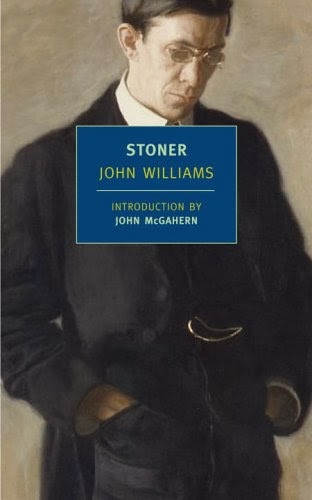
Stoner
Saturday, February 08, 2014
The disappearance of Majorana
I've just finished reading two books on the curious disappearance of Italian physicist Ettore Majorana. One by Leonardo Sciascia, and the other by João Magueijo titled A Brilliant Darkness. I'd recommend both. Sciascia's treatment, which appears as a kind of appendix in the NYRB edition of The Moro Affair (translated by Peter Robb), is more literary perhaps and more focused on Ettore Majorana the man rather than the details of his scientific interests. Magueijo's book is lighter and is funny, suspenseful, and informative (lots of neutrino physics). There's a review by Michael Brooks posted on the New Scientist blog CultureLab if you want the skinny on Magueijo's book.
 My interest in Ettore Majorana began a few years ago after reading a paper about Majorana fermions in topological insulators. That was probably back in 2009, right about the time A Brilliant Darkness was published. Since then Majorana fermions have been all over the condensed matter literature. Not a day goes by when I don't see a paper invoking Majorana states or modes. Naturally, I was curious about who the man behind these curious fermions might be. Until I found Sciascia's small book, I had to rely on number of incomplete articles about the physicist which are easily conjured up from the web with a simple search. What I didn't appreciate until reading Magueijo's book was just what an industry Majorana conspiracy theory is. There are films, documentaries, comic books, novels, and crankish web sites all devoted to solving the mystery of Majorana's unexplained disappearance. Magueijo remains objectively circumspect about what became of Majorana.
On the off chance that João Magueijo reads this post, I have a question for him: "What did Gilda Senatore say when you asked her why she never opened the box that Majorana gave her the day he disappeared? Or, perhaps more important, how did she react to the question? Guilty, puzzled, regretful?"
The real reason that I took the leap and read both Sciascia's and Magueijo's book is that I chanced on a reference to the missing Italian physicist in the novel Docteur Pasavento by Enrique Vila-Matas. An example of literature feeding back into my scientific life.
My interest in Ettore Majorana began a few years ago after reading a paper about Majorana fermions in topological insulators. That was probably back in 2009, right about the time A Brilliant Darkness was published. Since then Majorana fermions have been all over the condensed matter literature. Not a day goes by when I don't see a paper invoking Majorana states or modes. Naturally, I was curious about who the man behind these curious fermions might be. Until I found Sciascia's small book, I had to rely on number of incomplete articles about the physicist which are easily conjured up from the web with a simple search. What I didn't appreciate until reading Magueijo's book was just what an industry Majorana conspiracy theory is. There are films, documentaries, comic books, novels, and crankish web sites all devoted to solving the mystery of Majorana's unexplained disappearance. Magueijo remains objectively circumspect about what became of Majorana.On the off chance that João Magueijo reads this post, I have a question for him: "What did Gilda Senatore say when you asked her why she never opened the box that Majorana gave her the day he disappeared? Or, perhaps more important, how did she react to the question? Guilty, puzzled, regretful?"
The real reason that I took the leap and read both Sciascia's and Magueijo's book is that I chanced on a reference to the missing Italian physicist in the novel Docteur Pasavento by Enrique Vila-Matas. An example of literature feeding back into my scientific life.
Friday, February 07, 2014
The importance of reading
One of my colleagues alerted me to an article by Phil Davis in Scholarly Kitchen about a study of the reading habits of academics. Evidently there's some concern over whether scholars are reading more or less of the academic literature. While I was reading Davis' account of the study and its correction, I recalled Roberto Bolaño's dictum that reading is more important than writing.
 I'm not the fastest reader. In fact, I might be the slowest reader I know. Even my ten year old son reads faster than I do. Because I read so slowly, I tend to be choosey about what I read. And if a book doesn't work for me, I'll give it up. My personal library contains hundreds of half-read books (where "half-read" is defined as any value of pages greater than zero but less than the total). A lot of these books, I do plan on finishing one day. Just because I put down a book and don't finish it, doesn't mean the book is bad, just that there was something more pressing to read that bumped it off the stack.
Ten years ago, I started reading Thomas Pynchon's Gravity's Rainbow. I was enjoying the book. (I especially like the bit about the dodos.) But something happened when I got to page 120. I got distracted. (Brain cramp?) One day though, I'll get back to reading the remaining 640 pages.
So have I read Gravity's Rainbow? I'd say that I haven't read it. But I have read 15% of it. Does that count for anything?
Another thought occurred to me as I read Davis' Scholarly Kitchen piece: what does your typical academic consider to be reading? In order to read a paper, do you just need to read all the words in the article and examine the figures? What if there are mathematical formulae? Is it sufficient to glance at the formulae, or should you try to work from equation 1 to equation N along with the author? Have you read an article if you've read the abstract, introduction, and conclusions only? If we take a liberal view and say that an article has been read if one gathers as much as one needs from the text, then I've already read half-a-dozen articles today and will likely "read" a half-dozen more before my "academic work day" ends. But if I need to have read all the words in these articles, then I've read precisely zero articles.
What is the quanta of reading?
I'm not the fastest reader. In fact, I might be the slowest reader I know. Even my ten year old son reads faster than I do. Because I read so slowly, I tend to be choosey about what I read. And if a book doesn't work for me, I'll give it up. My personal library contains hundreds of half-read books (where "half-read" is defined as any value of pages greater than zero but less than the total). A lot of these books, I do plan on finishing one day. Just because I put down a book and don't finish it, doesn't mean the book is bad, just that there was something more pressing to read that bumped it off the stack.Ten years ago, I started reading Thomas Pynchon's Gravity's Rainbow. I was enjoying the book. (I especially like the bit about the dodos.) But something happened when I got to page 120. I got distracted. (Brain cramp?) One day though, I'll get back to reading the remaining 640 pages.
So have I read Gravity's Rainbow? I'd say that I haven't read it. But I have read 15% of it. Does that count for anything?
Another thought occurred to me as I read Davis' Scholarly Kitchen piece: what does your typical academic consider to be reading? In order to read a paper, do you just need to read all the words in the article and examine the figures? What if there are mathematical formulae? Is it sufficient to glance at the formulae, or should you try to work from equation 1 to equation N along with the author? Have you read an article if you've read the abstract, introduction, and conclusions only? If we take a liberal view and say that an article has been read if one gathers as much as one needs from the text, then I've already read half-a-dozen articles today and will likely "read" a half-dozen more before my "academic work day" ends. But if I need to have read all the words in these articles, then I've read precisely zero articles.
What is the quanta of reading?
Friday, January 24, 2014
Stoner by Williams

The day before yesterday, I started reading Stoner. I'm only a hundred pages in (a third of the way into the book), and my impression is that William Stoner, the titular character, has led an isolated life. The University which was his escape from farm life became another trap or asylum. Up to this point in the book, I've seen very little of Stoner's life in the academy. Perhaps English department politics will become the subject of the latter part of the book? Stoner's marriage to Edith is tragic. He's a modern man though, or before his time — he takes responsibility for the care and rearing of his daughter while Edith suffers from an illness which looks to me like depression.
Subscribe to:
Posts (Atom)